Delivery challan format and generator
Move goods without a sale, such as job work, supply on approval or branch transfers, with a proper delivery challan, and convert it into an invoice when the sale happens.
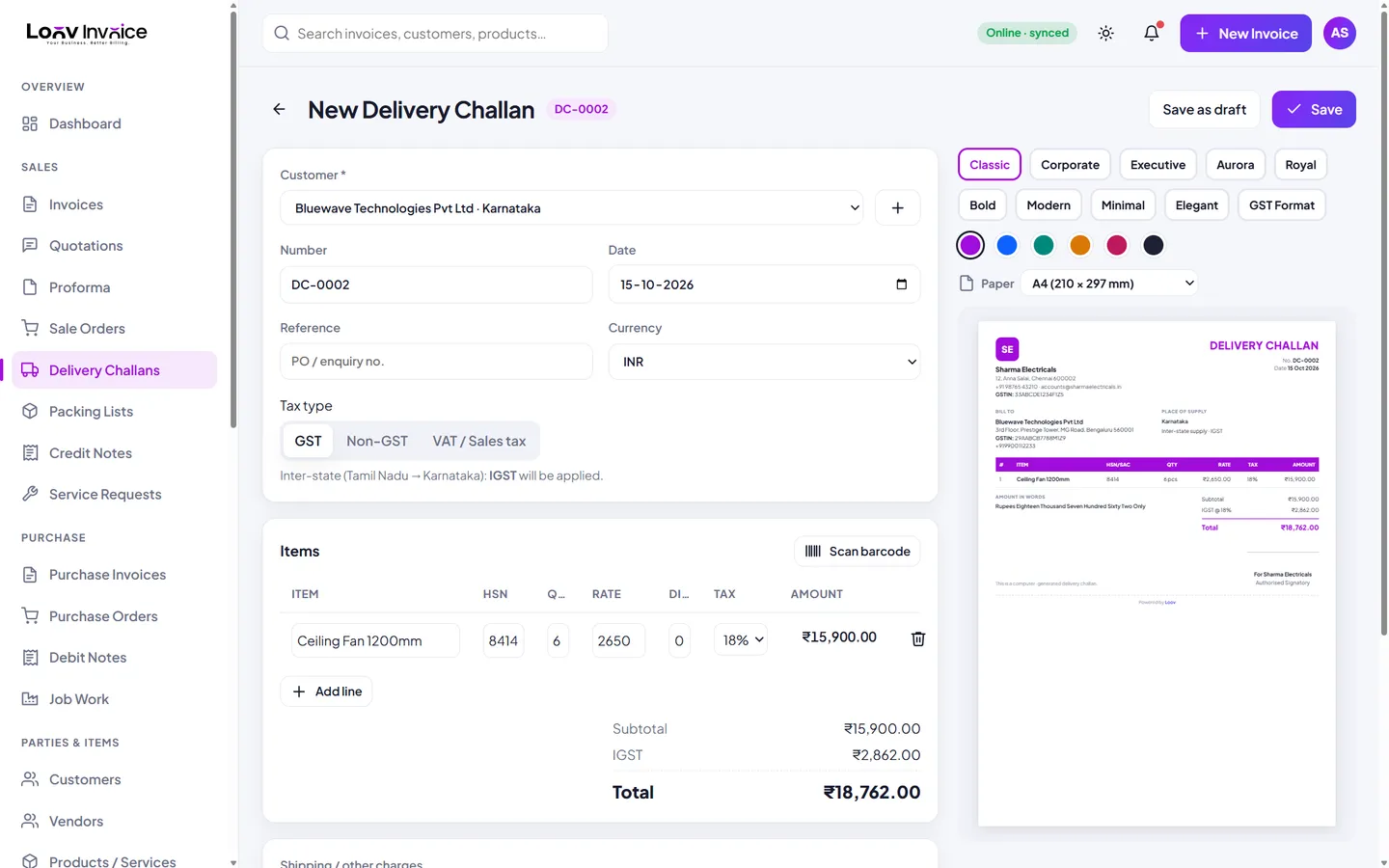
When is a delivery challan used?
A delivery challan goes with goods when they are transported but not sold at that moment. Common cases are goods sent for job work, supply on approval, goods sent for exhibitions, and moving stock between your own locations. When the sale is confirmed, you issue a tax invoice.
What a delivery challan includes
- Challan number and date
- Your name, address and GSTIN
- Consignee's name, address and GSTIN, if registered
- Description, HSN code, quantity and value of the goods
- Tax rate and amount, where the goods are taxable
- Place of supply and signature
A challan is usually issued in three copies: original for the consignee, duplicate for the transporter and triplicate for the consignor. Loov Invoice prints each copy with its label at the top.
Everything included
Converts to invoice
Turn a challan into a tax invoice when the sale is final.
Stock-aware
Products and HSN codes come from your inventory.
Copies with labels
Original, Duplicate (transport) and Office copies.
Packing lists too
Create packing lists and job-work challans as well.
How to do it in Loov Invoice
- Choose New Delivery Challan.
- Select the consignee and add the goods.
- Print or share the copies with the shipment.
- Convert it to an invoice when the sale is confirmed.
Frequently asked questions
Is a delivery challan a tax invoice?
No. It records the movement of goods. A tax invoice is issued when the supply becomes a sale.
Do I need an e-way bill as well?
Depending on the value and distance of the movement, an e-way bill may also be needed. Generate it on the e-way bill portal and note its number in the challan reference.
Start free. Your first invoice takes about a minute.
Free plan with 10 invoices every month. Pro is free for 15 days in India, with no card needed.